Healing the mind with wool
There was a time when I was waiting for a yarn delivery the way a child waits for Christmas. And writing this article felt a bit like trying to untangle a pile of threads in the dark.
Somewhere during that period, I realized just how much space knitting had actually taken over in my life. It wasn’t just a hobby – it was an anchor, a harbor, a quiet place… something that helped me keep my feet on the ground while everything around and inside me was absolute chaos. In the moments when I was at my worst -and surprisingly to me, they lasted quite a long time – I knitted. But I didn’t just knit. I had to do it. I felt like an addict, if I wasn’t knitting, I didn’t know what to do with myself, there was no space inside me, I felt incomplete. I was literally having panic attacks. Right now, it sounds strange to me, but that was the critical period when I felt a frantic, desperate need to do something, yet I couldn’t do anything…
At that time, my anxiety had turned every single thought into a constant sense of urgency. Everything had to be solved immediately, understood immediately, processed immediately. I was pushing myself to understand it all, to control my thoughts, the outcomes, everything… But knitting doesn’t work that way. Wool doesn’t work that way. It takes time.
I am a new knitter, discovered all of this just two or three years ago, starting and stopping several times, learning on the go. I’ve always loved making things with my hands, so this was a natural extension, but in my case, it turned out to be something much more – an inner necessity. Because I am one of those “anxious people,” I am used to rushing, hurrying, making lightning-fast decisions, and replaying everything that happened in my head a hundred times over. My mind races ahead, wanting to solve and finish things quickly. Right here, knitting helps me inhale and exhale, to just follow the rhythm and not rush. It teaches me patience, it teaches me to live slowly, to feel…
Healing your mind is like a textbook on slow living. And for me, wool is the best teacher.
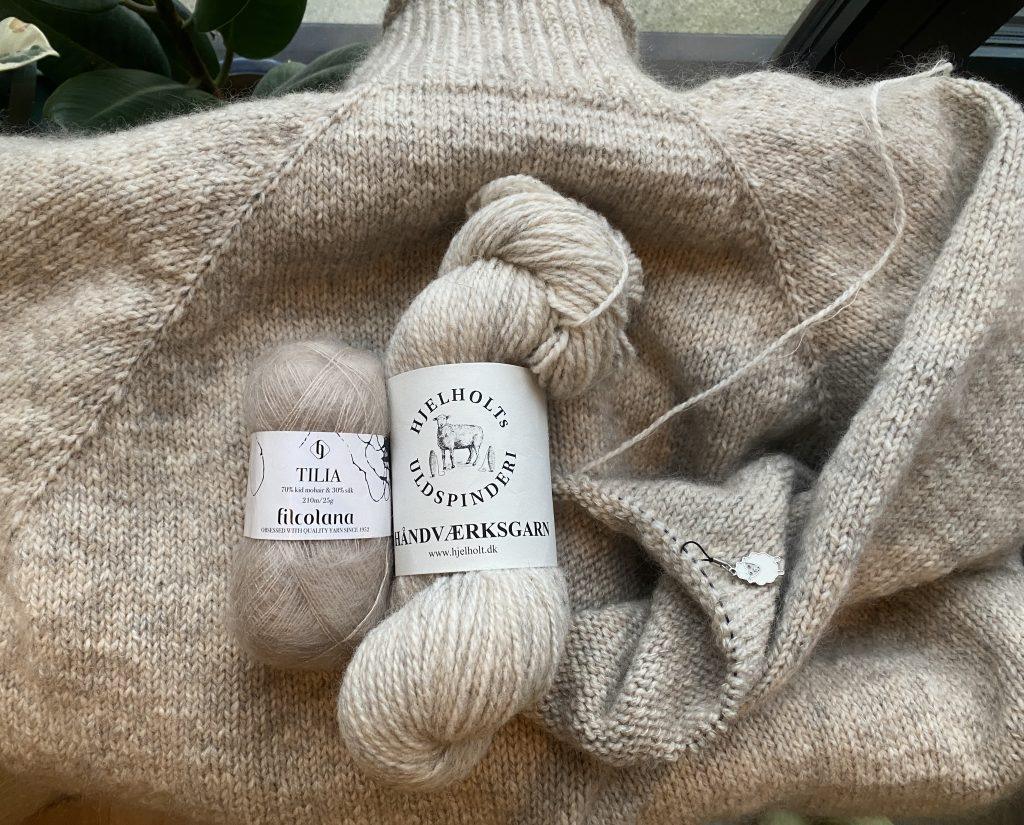
When I say wool, I don’t mean just something bought off a shelf. I am talking about real, rustic, warm, and breathing yarn – the kind I waited for during those heavy few days I mentioned earlier. This specific yarn comes from the Danish spinning mill, Hjelholt. Founded back in 1878, this family-run mill in Southern Fyn, Denmark, is currently managed by the fourth and fifth generations of the family, who continue to use traditional methods and restored machinery from the 1940s. A slow process, living wool, gorgeously warm knitwear. I haven’t knitted with all of their yarns – I only know two of them: Håndværksgarn and Triple, but they are so good that I don’t need anything else. And somehow, it was through these two yarns that I started to understand all of this more clearly in practice, not just in theory.
(This is not an ad, I get nothing in return, though I’d be happy if it were the other way around 🙂)
Håndværksgarn is the classic “craft” yarn. It is 100% wool—a blend of Gotland and merino. It is dense, authentic, spun in two plies. When you knit with it, you feel real, traditional wool in its purest form. It has that rustic, honest texture that doesn’t pretend to be anything other than what it is. It knits up incredibly easily – when frogging, the thread doesn’t break, tangle, or snag, which is an absolute blessing. The strand has irregularities – to the touch, it feels a bit dry, but that dryness was deceptive – I realized this when I waited 15 minutes for it to soak, and it simply refused to sink in the washbasin. After blocking, it softens significantly, blooms, and is incredibly forgiving of uneven stitches, even though the heathered melange doesn’t hide mistakes easily.
And yet, the experience changes completely when I switch to something more complex.
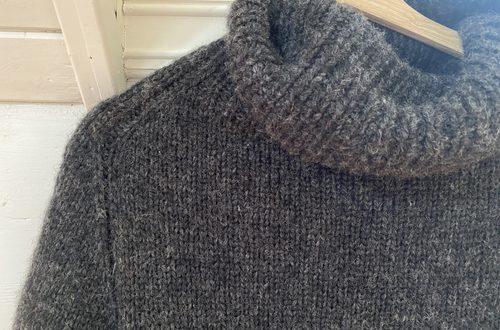
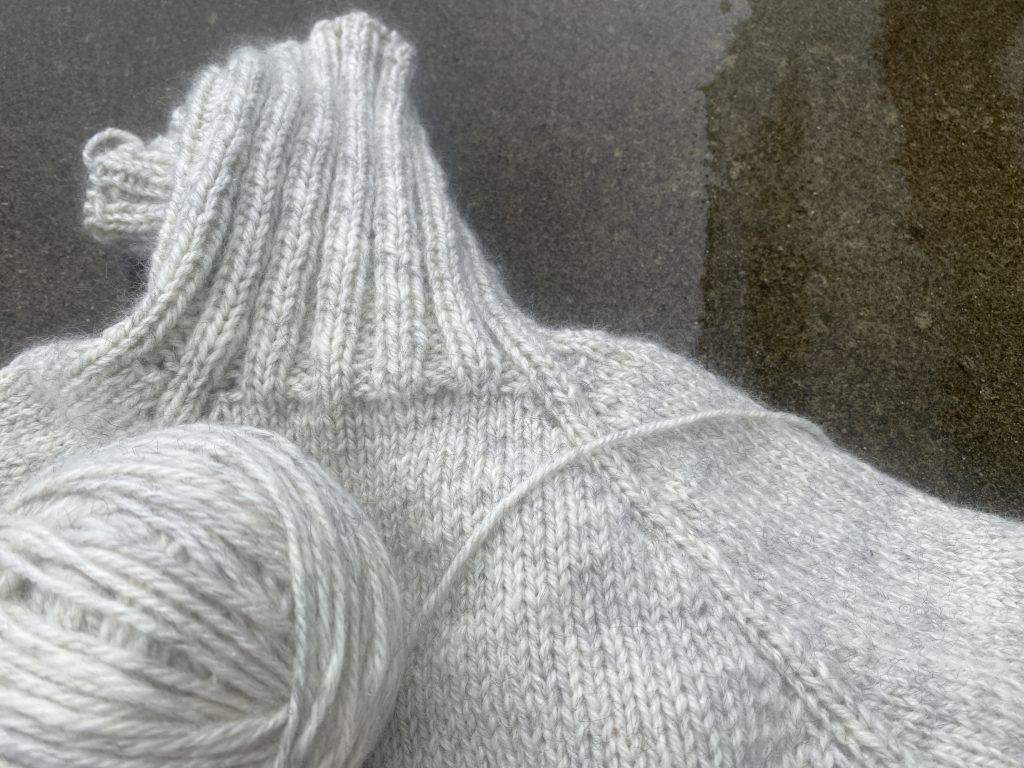
Triple, on the other hand, is a completely different alchemy. It is more complex – three plies, where Gotland wool and merino meet 14% mohair. To a non-knitter, these are just percentages, but to me, it’s a pure dose of poetry about winds, fjords, and rain. The Gotland wool provides that grey, melange core, the strength, and the characteristic sheen of the long fiber – it’s the part that “pricks” and carries that wild character. The merino balances the roughness, while the thin strand of mohair wraps everything in a light, discreet halo that catches the light and softens the structure. I’m currently using it to knit a sweater with a quite high collar that I am designing as I go. Despite all the wool, the collar feels soft even now, before blocking, which makes me think it will be even less prickly afterward.
It is amazing how wool transforms after washing. How it becomes more obedient, how it slightly changes its size and softness, and once you put it on, it seems to remember who its owner will be. It’s as if it holds some kind of ancient memory.
Knitting with them is like carrying on a continuous dialogue with the material. Their strands are alive, sometimes uneven – they have their own opinion on how they will lay in the fabric. And at some point, I realized this wasn’t just about the material anymore. This wool – and any wool that hasn’t been processed to death, has resistance and character. It is often rough, lively, prickly, the exact opposite of the softness most people want and expect. But for me, that slight prickle as the yarn passes through my fingers seems to say:
“Well, yes, I am rough, but because of that, I’ll be around for a long time. I will keep you warm, and you’ll thank me when the wind starts to blow.”
And exactly this lack of industrial, plastic perfection pulls me out of the urgency of my own mind. When I started my very first sweater, I thought everything would be about the final result – the shape and how it would look. But actually, the most important thing happens between the stitches – in the repetition, in the rhythm. It is meditative to do the exact same movement over and over again without getting an immediate result. You sit there, you knit, and at first, it looks like nothing, just a moving thread. Little by little, a shape begins to appear. Slowly. Almost imperceptibly, until one day you look down and see that something already exists.
For me, that is perhaps the strangest part, that the result comes without you pulling it toward yourself. It just happens, if you stay in the process long enough. In my case – sitting in the armchair, surrendering entirely to my senses, and letting my hands lead the way. The whole process is an adventure where the reward is at the finish line, but you’ve learned so much along the way. And it wasn’t something I understood immediately, it showed up later, in my body, not in my thoughts.
Wool calms me. It might be funny, and it’s probably just my own strange truth, but yarn acts like a real therapy for me.
It grounds me – the warmth, the touch, the scent… all the things you’re told to do in moments of intense anxiety: “smell one thing, touch two things…”
Row after row, stitch after stitch, inhale, exhale… Live.
Maybe that’s why, for me, knitting with wool is the opposite of the world we live in. It comes from places where time is measured in a completely different way. And sometimes, I can feel that difference even while I’m just sitting and knitting, stitch by stitch.